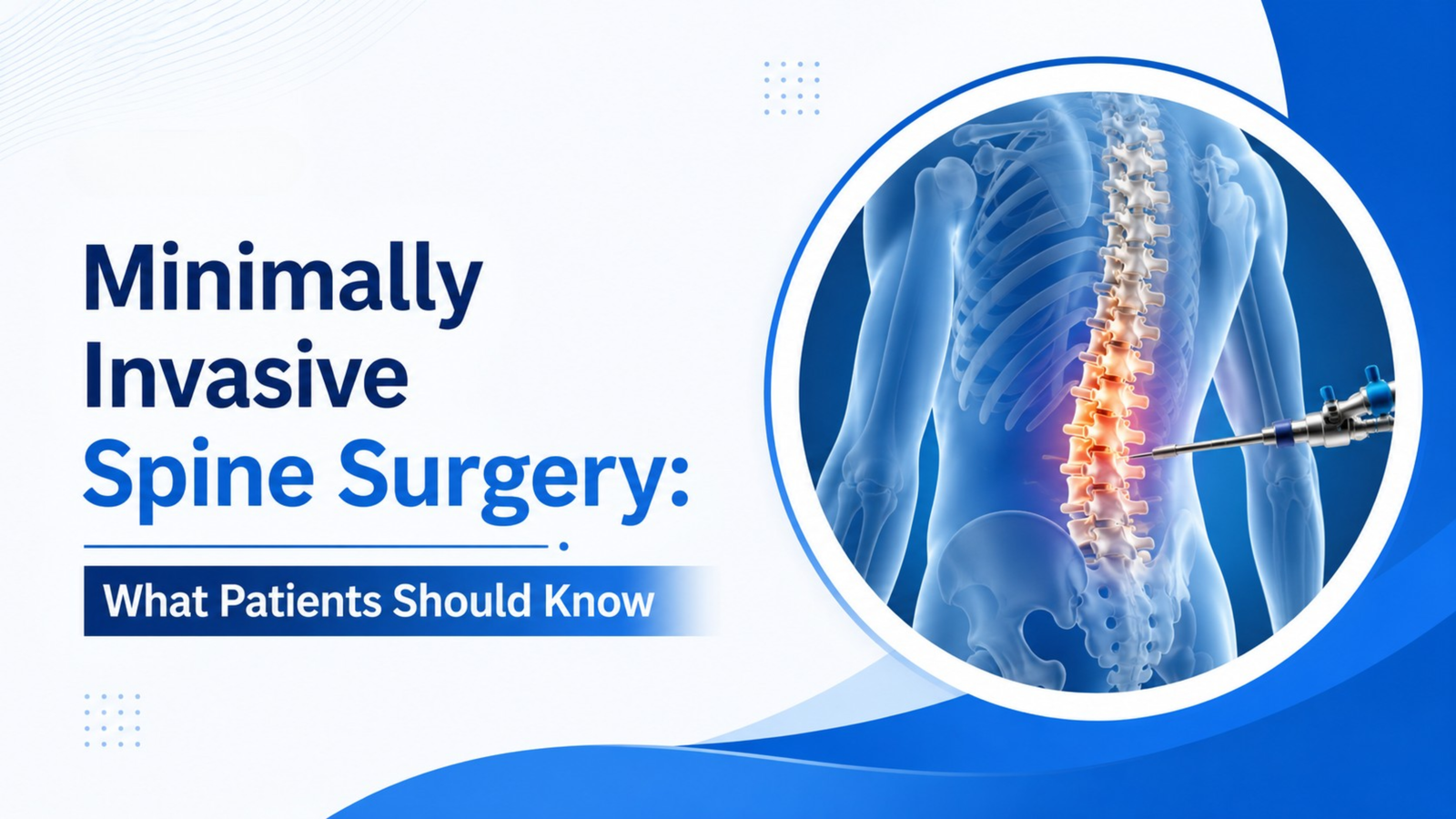
Minimally Invasive Spine Surgery (MISS) is an advanced approach used to treat selected spinal conditions through smaller incisions and specialized surgical techniques. Unlike traditional open spine surgery, minimally invasive procedures aim to reduce disruption to surrounding muscles and soft tissues while addressing the underlying spinal problem. Depending on the condition, MISS may be considered for herniated discs, spinal stenosis, nerve compression, and certain degenerative spine conditions. Potential benefits may include smaller incisions, reduced blood loss, less postoperative discomfort, and a shorter recovery period in appropriately selected patients. However, minimally invasive surgery is not suitable for every condition, making detailed clinical evaluation and imaging essential before treatment.
Minimally Invasive Spine Surgery: What Patients Should Know
Minimally Invasive Spine Surgery (MISS) has become an important option in modern spine care for appropriately selected patients. Traditional spine surgery may require larger incisions and greater exposure of the spinal structures. Minimally invasive techniques are designed to access the affected area through smaller incisions while attempting to preserve as much of the surrounding muscle and soft tissue as possible.
For patients experiencing persistent back pain, neck pain, nerve compression, or other spinal problems, understanding how minimally invasive spine surgery works can help them make informed treatment decisions. However, it is important to remember that minimally invasive surgery is not automatically the best option for every spinal condition. The appropriate procedure depends on the diagnosis, symptoms, imaging findings, overall health, and individual treatment goals.
What Is Minimally Invasive Spine Surgery?
Minimally invasive spine surgery uses specialized instruments, advanced imaging, microscopes, or endoscopic technology to access the affected part of the spine through relatively small surgical openings.
The primary goal is to treat the underlying spinal problem while limiting unnecessary disruption to nearby muscles, ligaments, and other soft tissues.
Depending on the condition, the surgeon may remove a portion of a herniated disc, relieve pressure from a compressed nerve, remove bone or tissue causing spinal narrowing, or stabilize selected spinal segments.
The exact technique depends on the location and nature of the spinal problem.
Which Conditions Can Be Treated?
Minimally invasive techniques may be considered for selected patients with conditions such as:
- Herniated or slipped discs
- Nerve compression
- Certain cases of spinal stenosis
- Degenerative disc conditions
- Selected lumbar spine problems
- Certain cervical spine conditions
- Some spinal fractures
- Selected cases requiring spinal stabilization
Not every patient with these conditions is automatically a candidate for minimally invasive surgery. Careful evaluation is necessary to determine whether the technique can safely and effectively address the underlying problem.
How Is Minimally Invasive Spine Surgery Performed?
Before surgery, the patient undergoes a detailed evaluation. The spine specialist may review the patient's symptoms, medical history, physical examination, and imaging studies such as MRI, CT scans, or X-rays.
During the procedure, the surgeon makes one or more small incisions near the affected spinal region. Specialized instruments are carefully guided toward the treatment area.
Depending on the procedure, a microscope or endoscope may provide magnified visualization of the spinal structures. The surgeon can then perform the required treatment, such as removing herniated disc material or decompressing a nerve.
Once the procedure is completed, the instruments are removed and the incision is closed.
What Are the Potential Benefits?
One of the major objectives of minimally invasive spine surgery is to reduce unnecessary tissue disruption.
Depending on the specific procedure and patient, potential benefits may include:
- Smaller surgical incisions
- Less disruption of surrounding muscles
- Reduced blood loss
- Less postoperative discomfort
- Smaller scars
- Earlier mobilization
- Potentially shorter hospital stay
- Potentially faster return to daily activities
However, results vary between patients. A minimally invasive approach does not guarantee faster recovery or better results in every situation.
The most important factor is choosing a procedure that appropriately treats the underlying spinal condition.
Is Minimally Invasive Surgery Safer Than Traditional Surgery?
Minimally invasive spine surgery can offer advantages for appropriately selected patients, but it is still a surgical procedure and carries potential risks.
Possible complications can include infection, bleeding, nerve injury, recurrent disc problems, persistent symptoms, or the need for additional treatment. The specific risks depend on the procedure and the patient's individual health.
In some complex spinal conditions, conventional open surgery may provide better access and may be more appropriate.
Therefore, patients should not choose a procedure simply because it is described as “minimally invasive.” The surgical approach should be based on clinical need.
Who May Be a Candidate?
Patient selection is an important part of minimally invasive spine surgery.
A patient may be considered when:
- The source of symptoms has been accurately identified
- Imaging confirms a treatable structural problem
- Symptoms are significant or persistent
- Appropriate non-surgical treatments have not provided sufficient relief
- The spinal condition can be safely addressed through a minimally invasive approach
A detailed examination and review of imaging help determine whether minimally invasive surgery is appropriate.
Role of MRI and Other Imaging
Imaging plays an important role in planning minimally invasive spine surgery.
An MRI scan can help identify disc herniation, nerve compression, spinal stenosis, and other soft-tissue abnormalities. X-rays may be used to evaluate spinal alignment and movement, while CT scans can provide detailed information about the bones.
However, imaging findings should not be considered in isolation. Many people have degenerative changes on MRI without experiencing significant symptoms.
The treatment decision should therefore be based on the combination of symptoms, clinical examination, and imaging findings.
Recovery After Minimally Invasive Spine Surgery
Recovery depends on the type of surgery, the spinal condition being treated, and the patient's overall health.
Some patients may be able to walk relatively soon after surgery. However, activity should be increased gradually according to the surgeon's instructions.
Patients may initially be advised to avoid heavy lifting, excessive bending, strenuous exercise, or other activities that could interfere with recovery.
Physiotherapy may be recommended to improve strength, flexibility, posture, and functional movement.
Regular follow-up appointments are important for monitoring healing and recovery.
Minimally Invasive vs. Traditional Spine Surgery
The main difference between minimally invasive and traditional surgery is the surgical approach used to access the spine.
Traditional surgery may require a larger incision and greater exposure of the spinal structures. Minimally invasive surgery generally uses smaller openings and specialized instruments designed to reduce disruption to surrounding tissues.
However, minimally invasive surgery cannot replace conventional surgery in every situation. Complex deformities, extensive spinal instability, certain tumors, severe trauma, or other complicated conditions may require different surgical approaches.
The best technique is the one that provides effective and appropriate treatment for the patient's condition.
Questions Patients Should Ask Before Surgery
Before undergoing minimally invasive spine surgery, patients should discuss important questions with their spine specialist, such as:
- What is causing my symptoms?
- Is surgery necessary?
- Are there non-surgical treatment options?
- Am I a suitable candidate for minimally invasive surgery?
- What procedure is being recommended?
- What are the potential benefits and risks?
- How long is the expected recovery?
- Will physiotherapy be required?
- Are there alternative surgical approaches?
Having clear answers can help patients understand their treatment and make an informed decision.
Conclusion
Minimally Invasive Spine Surgery provides an advanced treatment option for selected spinal conditions. By using smaller incisions and specialized surgical techniques, it aims to treat the underlying problem while minimizing disruption to surrounding tissues.
Potential advantages may include smaller scars, reduced tissue damage, less blood loss, and potentially faster recovery. However, the technique is not suitable for every patient or every spinal condition.
The most important step is obtaining an accurate diagnosis and consulting an experienced spine specialist. A personalized evaluation can help determine whether minimally invasive spine surgery is appropriate and which treatment approach is most suitable for achieving the best possible outcome.